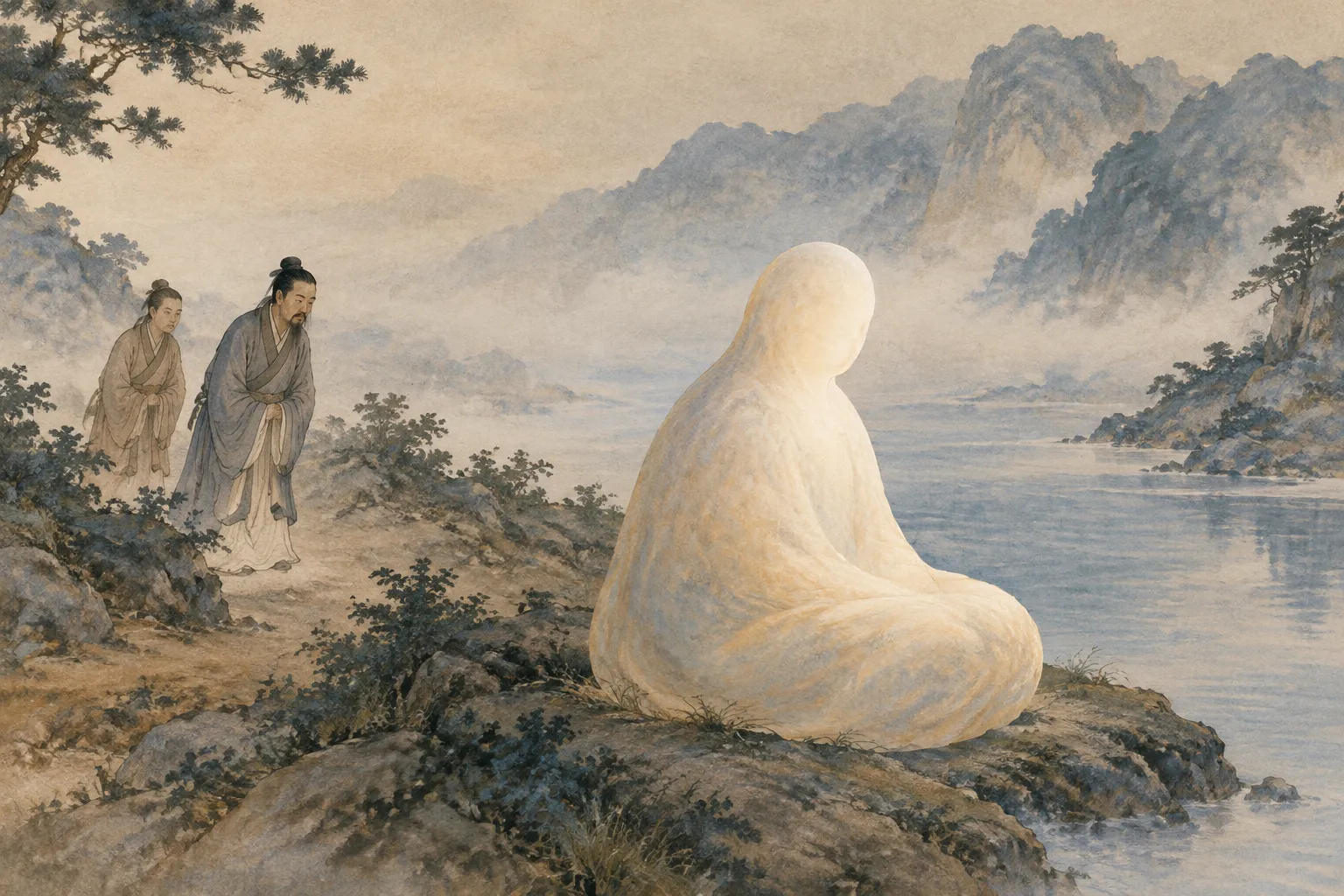
Two rulers decide to give their host a present: the openings of a human face. Their host, Hundun, has none. To the visitors, this seems like something to correct. They make one opening each day. On the seventh day, Hundun dies. The Stanford Encyclopedia of Philosophy recounts this disturbing episode from chapter seven of the Zhuangzi, where the production of a recognizable human body ends a life rather than completing it.
Why should an apparently helpful transformation prove fatal? Reading the story as a puzzle, rather than reducing it to a slogan, reveals its unsettling force. What looks incomplete to an observer may not be incomplete at all. And a gift can become destructive when its giver never questions the standard behind it.
1. Where the story belongs
The episode belongs to Ying di wang, chapter seven of the Zhuangzi, whose title the Internet Encyclopedia of Philosophy renders as “Responding to Emperors and Kings.” It is the last of the seven Inner Chapters. This is a particular literary setting, not an anonymous folktale collected from a named village or a description of a festival ceremony.
Its historical placement needs care. Zhuang Zhou, the thinker associated with the book, belongs to the Warring States intellectual world, particularly the fourth century BCE. Yet the surviving work is a compilation. The Stanford entry on the text’s formation explains that Guo Xiang, who died in 312 CE, reduced an earlier collection of fifty-two chapters to the thirty-three now received. Even direct authorship of the Inner Chapters remains a hypothesis rather than a demonstrable fact.
It is therefore more precise to say “the Zhuangzi tells this story” than to imagine a securely documented moment when a historical author composed it. That distinction does not weaken the tale. It tells us what kind of evidence we have: a transmitted literary work with a complicated history.
2. Why making someone human can be a catastrophe
In the episode, Hundun occupies the center, while the other two emperors belong to the north and south. His body lacks the openings the visitors associate with human life. The seven are understood as the eyes, ears, nostrils, and mouth. The scholarly account of Hundun’s transformation makes the paradox explicit: their effort to make him resemble a human ends with his death.
One way to read that paradox is to distinguish difference from deficiency. The visitors recognize a difference and immediately treat it as a deficiency. Their model of a proper body supplies both the diagnosis and the remedy. There is no space, within that reasoning, for the possibility that Hundun is already whole.
This is an interpretation, not a translated moral appended to the tale. Its usefulness lies in the question it makes us ask: who gets to decide what another being needs? If the answer is simply “whoever possesses the familiar model,” then understanding has been replaced by resemblance.
The ending also frustrates an easy equation between appearance and flourishing. A body can become more recognizable to outsiders while becoming less able to live. Read this way, the story is not an argument against human faces. It is a challenge to the assumption that a human pattern must be the measure of every possible life.
3. “Chaos” does not simply mean disorder
Hundun’s name introduces another difficulty. The Stanford discussion of Daoist cosmogony explains that hundun is commonly translated as “chaos” or “the inchoate”: something not yet fully differentiated, from which a cosmos can emerge. Here, “chaos” should not automatically suggest a disastrous mess requiring repair.
That distinction changes the reader’s expectations. If chaos means only confusion, then imposing order sounds beneficial. If it names an undivided condition with its own integrity, differentiation becomes more ambiguous. Making distinctions may produce a world we recognize, but it may also destroy something that existed before those distinctions.
The same encyclopedia summarizes Norman Girardot’s interpretation connecting Hundun’s death with the movement from primordial unity toward duality and social institutions. That is a cosmological and social reading, not merely advice about personal manners. It asks what the creation of an ordered world costs.
We need not choose between a bodily reading and a cosmic one as though only one could matter. As an interpretive exercise, the body can make an abstract problem tangible. The disturbing possibility is that what we celebrate as completion may look very different from the standpoint of what has been transformed.
4. Why a chapter about rulers matters
The chapter’s political setting gives the episode another edge. The Internet Encyclopedia’s account of chapter seven emphasizes the possibility of allowing social life to follow its own tendencies rather than subjecting it to deliberate interference. Its discussion treats restraint as connected both with preserving life and with allowing a community to function.
Against that background, Hundun’s fate invites a political question: when does a ruler’s improvement become an injury? A governing authority may possess a coherent plan, admirable intentions, and the power to carry it out. None of those qualities, by themselves, demonstrates that the plan fits those who must live under it.
This need not mean that every intervention is wrong. Such a conclusion would itself turn a suggestive story into a rigid universal rule. A more cautious reading asks what a ruler has noticed, what the ruler has assumed, and whether the people or beings affected can flourish otherwise.
Readers interested in the wider relationship between Daoist ideas and practice can continue with the influence of Daoism on Chinese ceremonial practices. The distinction matters: this article examines a literary episode, not evidence that a particular community performed a Hundun ceremony.
5. A story that resists becoming a rule
Why not explain the lesson directly? The Stanford account of the Zhuangzi’s literary method describes brief, imaginative exchanges whose implications are often left unstated. Their open-endedness invites readers to participate in the thinking rather than receive a finished doctrine.
Hundun’s story rewards that approach. “Never help anyone” would be a poor conclusion. So would “all order is evil.” Neither distinguishes attentive care from the imposition of a template. The more demanding question is whether help responds to another life or replaces it with the helper’s idea of what life should be.
Nor should the cosmic interpretation erase the individual figure. We can consider the emergence of a differentiated world and still be troubled by a death. Holding those responses together makes the tale harder, and more interesting, than a simple celebration of either civilization or primordial unity.
Its most durable challenge may be a pause before correction: what makes us so certain that the unfamiliar is unfinished? That question is a proposed reading, not an ancient quotation. It leaves the reader where this unsettling episode works best—less confident about the obvious remedy, and more attentive to the life already present.
Sources and further reading
- Religious Daoism — Stanford Encyclopedia of Philosophy. See the sections on early texts and cosmogony for the Hundun episode and its cosmological interpretation.
- Zhuangzi — Internet Encyclopedia of Philosophy. Historical background, textual organization, and an interpretation of chapter seven.
- Zhuangzi — Stanford Encyclopedia of Philosophy. Textual formation, authorship uncertainties, and the interpretive character of the book’s parables.