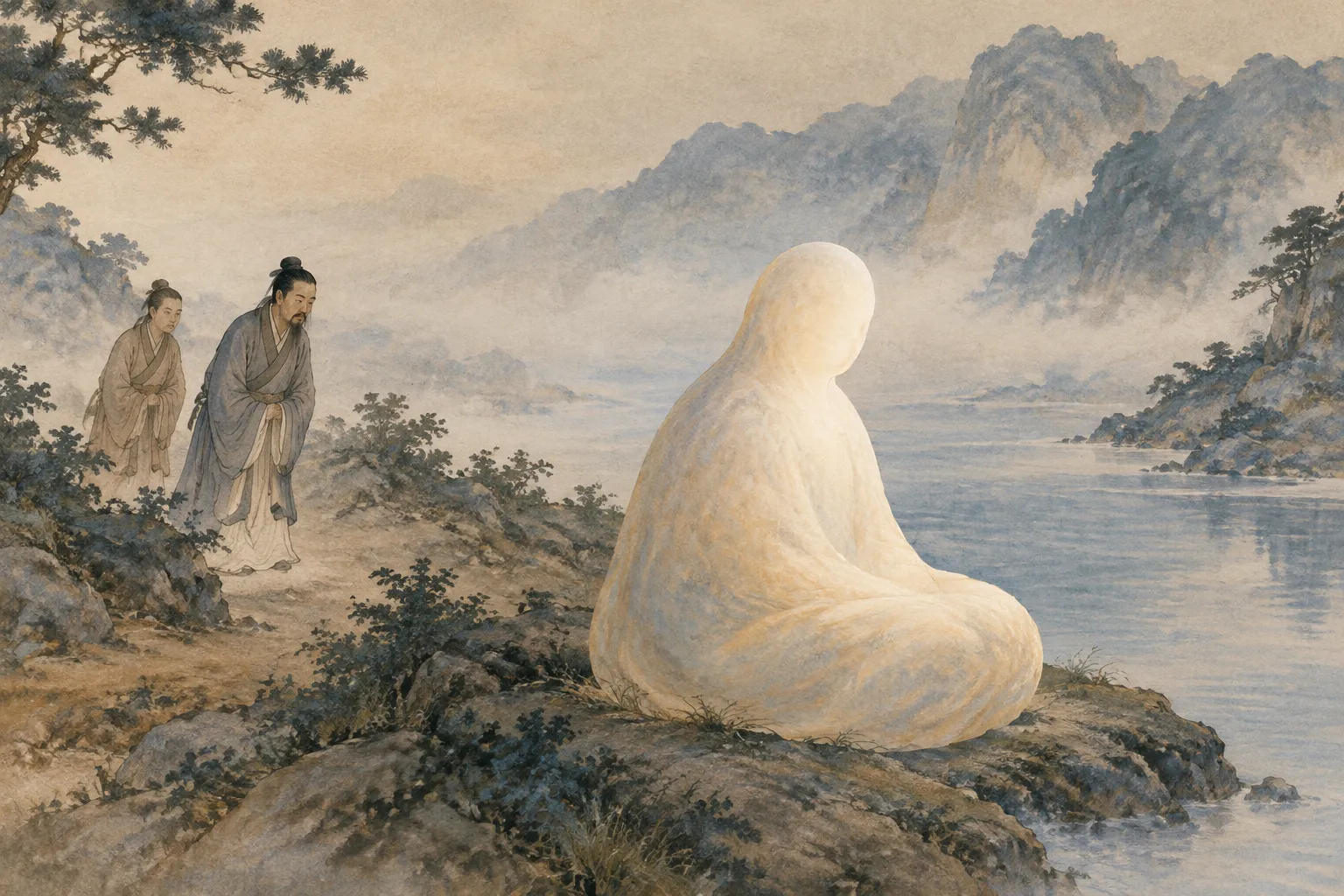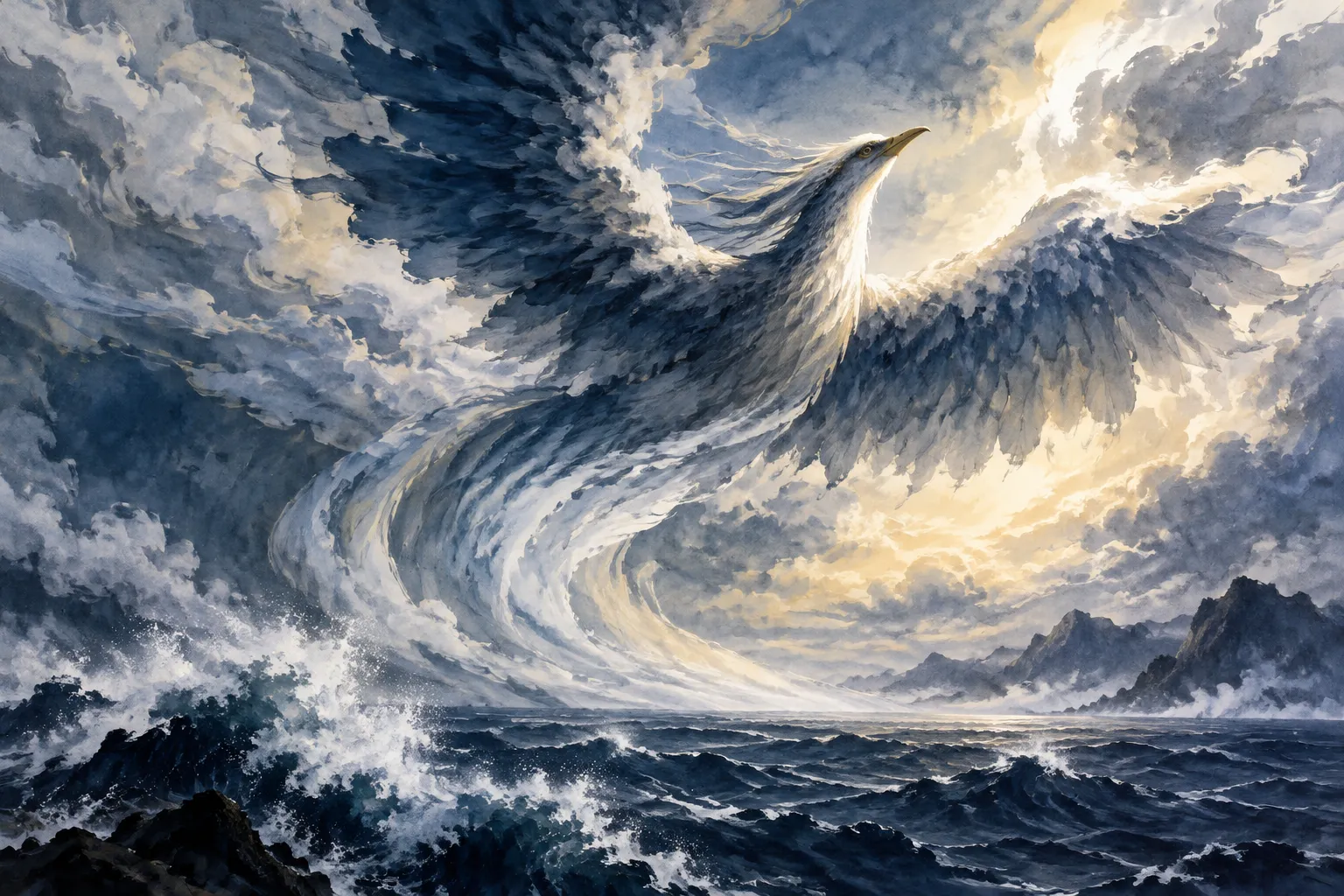
The bird is almost too large to imagine. Its wings resemble clouds hanging across the sky. Before it was a bird, it was a fish whose dimensions the narrator could not measure. Now it rises from the northern sea and turns toward the south. Yet the most revealing detail in this extraordinary flight may be the least spectacular: without enough wind underneath it, the giant cannot fly. That dependence is explicit in the opening chapter of the Zhuangzi.
Why give such an immense creature such a definite limitation? Reading the Peng’s journey closely reveals more than a celebration of soaring ambition. The story asks how different creatures understand the world—and whether traveling farther necessarily means becoming free.
A marvelous creature in a philosophical text
The Peng appears at the beginning of Xiaoyao you, the first of the Zhuangzi’s seven Inner Chapters. Its title is often translated as “Free and Easy Wandering”; James Legge’s nineteenth-century translation calls it “Enjoyment in Untroubled Ease.” These renderings place freedom and ease before the reader even before the enormous fish appears. The Internet Encyclopedia of Philosophy’s discussion of chapter one emphasizes wandering beyond familiar boundaries rather than merely enjoying leisure.
The historical thinker Zhuang Zhou belongs to the late fourth century BCE, during China’s Warring States period. But the book bearing his name is a compilation, not a securely documented single-author manuscript. Its surviving thirty-three-chapter arrangement owes much to the later editor Guo Xiang, who died in 312 CE. As the Stanford Encyclopedia of Philosophy explains, even the traditional attribution of the Inner Chapters to Zhuang Zhou remains a hypothesis.
Here, therefore, “Zhuangzi’s story” means the story preserved in that received text. It is a philosophical narrative using marvelous beings, not a record of an observed animal or, on the evidence considered here, a description of a local bird cult. Keeping that distinction clear lets us enjoy its mythic scale without inventing a religious setting for it.
From the northern fish to the southern sea
The chapter opens with Kun, a fish in the northern ocean. The narrator repeatedly declines to specify its full size. Kun then changes into Peng, whose back is likewise beyond ordinary measurement. When the bird rouses itself, its wings spread like vast clouds; when the sea moves, it prepares to journey to the southern ocean, identified as the Pool of Heaven. These are the opening movements in the Legge and Giles translations presented alongside the Chinese text.
The narrative then invokes a work called Qi Xie, described in Legge’s rendering as a record of marvels. Its reported account supplies astonishing figures: Peng strikes the water across three thousand li and ascends on a whirlwind to ninety thousand li. The wording concerning six months differs between the historical translations. Rather than making a precise flight timetable out of it, we can recognize the central effect: this journey operates on a scale far beyond familiar travel.
Those numbers should not be converted into a modern aviation chart. In this reading, their narrative force lies in stretching the imagination. The narrator combines enormous measurements with admissions of not knowing, giving the journey grandeur without making it entirely graspable.
Nor does the chapter simply move on after telling the story once. A later passage, framed through a question by Tang to Ji, describes a northern fish and a bird whose back resembles Mount Tai. The Peng again ascends on a whirlwind and heads south. This is a second telling within the same chapter, not necessarily evidence of a separately collected regional tradition. Its repetition brings the difference between small and great lives back into view.
The small creatures are not impressed
From below, the journey looks absurd. In Legge’s translation, a cicada and a little dove laugh at Peng. They can launch themselves toward nearby trees, sometimes falling short. Why should flight require an ascent of ninety thousand li? In the later telling, a small marsh bird likewise treats its own short flights among the vegetation as sufficient. Both episodes belong to the chapter’s recurring contrast between small and great.
The humor comes from the mismatch between experience and judgment. The little creatures know their own movements, but they assume those movements establish what all flying should be. A nearby branch becomes the measure of an ocean-crossing journey.
The text follows the first exchange with travelers who require different provisions. Someone going a short distance needs little preparation; a long journey requires much more. That comparison makes the birds’ disagreement less remote. Different undertakings need different conditions. A supply that would be excessive for one traveler may be essential for another.
One useful interpretation is that the little creatures mistake familiarity for completeness. Their error is not simply having small bodies. It is treating a limited field of experience as an adequate basis for dismissing everything beyond it. The Internet Encyclopedia of Philosophy develops a related reading, emphasizing an expansive understanding that moves beyond the boundaries of ordinary distinctions.
The wind is not a decorative detail
Yet Peng’s size does not make it self-sufficient. The chapter explains its flight through an unexpectedly domestic comparison: water poured into a small hollow can float a piece of straw, but not a cup. A large boat needs deep enough water. Likewise, enormous wings require a sufficiently great accumulation of wind. This analogy appears directly in the primary-text translations.
The analogy changes how we see the spectacle. Peng does not simply triumph over the air through strength. Its wings can function because the surrounding conditions support them. The greater creature has correspondingly greater requirements.
This need not turn Peng into a failure. Dependence makes its flight intelligible within the story. But it complicates an easy motivational reading in which the giant bird represents a person who succeeds by willpower alone. Its astonishing movement is possible through a relationship between body, atmosphere, and timing.
The chapter later makes dependence explicit in the case of Liezi, who rides the wind. Despite escaping the labor of walking, he still relies on something. The text then imagines a more unrestricted wandering and asks what such a wanderer would depend upon. Read beside that passage, Peng’s supporting wind becomes more than scenery: it helps frame the chapter’s question about the conditions of freedom.
A larger view is still a view
Another small interruption prevents the flight from becoming a straightforward ascent toward final knowledge. The chapter asks whether the sky’s blue appearance is its actual color or an effect of distance and vastness. It then imagines the corresponding view from above. Even after launching the reader into the heights, the narrative introduces a question about appearance and position. The question is preserved in the opening Peng passage.
My reading is that this makes the story productively unsettling. The little creatures should not assume that their nearby world exhausts reality. But readers should also hesitate before assuming that a magnificent elevated viewpoint automatically resolves every uncertainty. Greater range and unlimited understanding are not obviously the same thing.
That is an interpretation, not an uncontested moral supplied by the narrator. The Stanford Encyclopedia of Philosophy’s account of the text’s open-ended parables is useful here: their attraction often lies in inviting further reflection rather than delivering an explicit, final lesson.
Readers interested in another striking use of a marvelous being can turn to the Zhuangzi’s tale of Hundun and the seven openings. The questions differ, but both stories reward attention to a concrete bodily detail rather than treating the creature as a symbol with one fixed meaning.
Peng’s flight remains exhilarating. Nothing in a careful reading requires making it ordinary. What changes is where we look: not only at the wings spread across the heavens, but at the wind carrying them. The story’s giant opens a wider world while leaving us with a sharper question—what supports the freedom we think we possess?
Sources and further reading
- The Zhuangzi, Inner Chapters: Chinese text with historical translations by James Legge and Herbert A. Giles; chapter one is the primary narrative discussed here.
- Stanford Encyclopedia of Philosophy: Zhuangzi: textual history, authorship cautions, and interpretive approaches.
- Internet Encyclopedia of Philosophy: Zhuangzi: historical context and an interpretation of wandering beyond familiar boundaries.