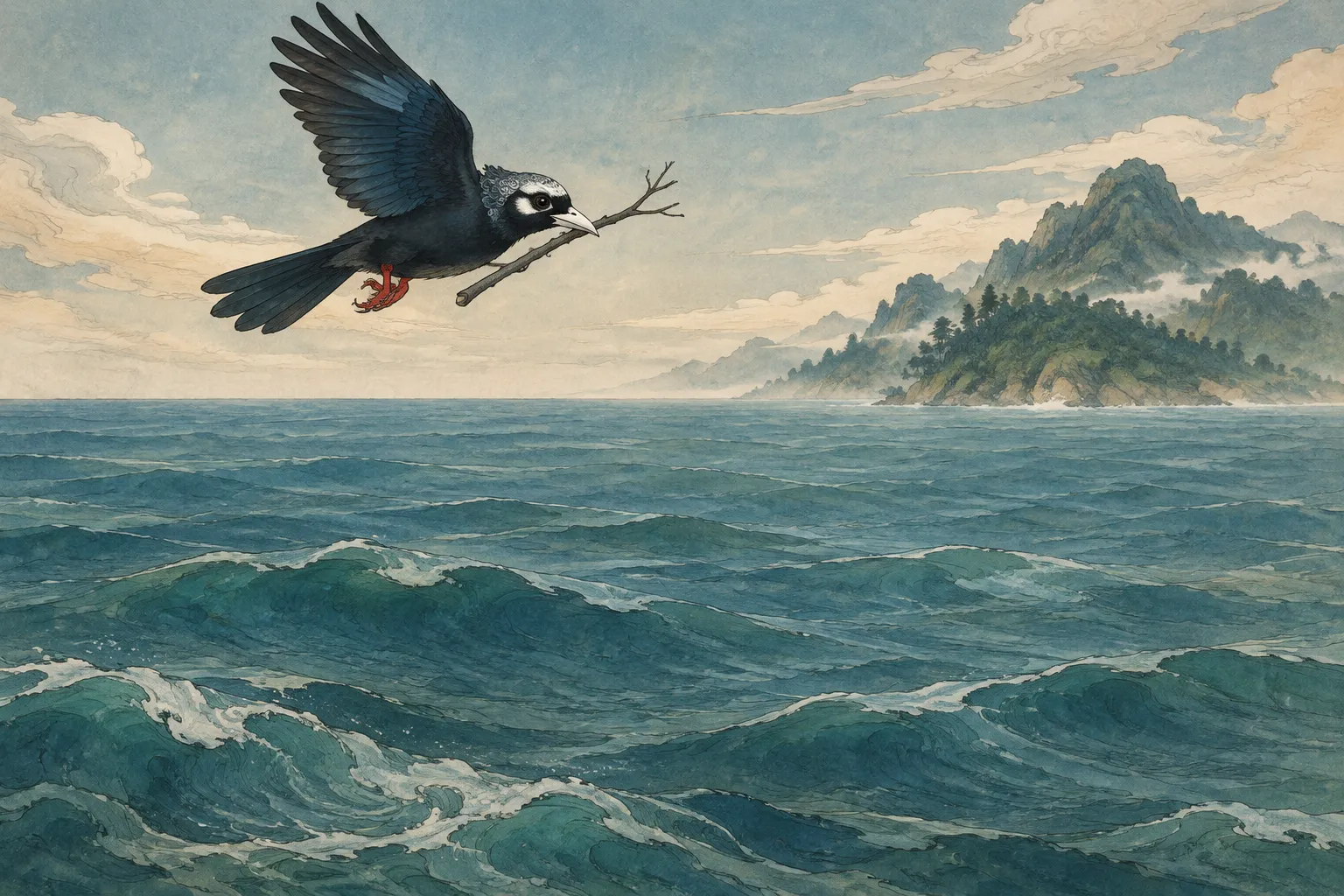
A bird carries a twig toward the sea. Against that expanse of water, its burden looks almost weightless. Yet the disproportion is the point: Jingwei intends to fill the sea, one small delivery at a time. In David K. Jordan’s retelling hosted by UC San Diego, she is a drowned girl transformed into a bird, determined both to answer her own death and to prevent others from drowning.
That makes her task more troubling than a simple lesson about working hard. Is she seeking revenge, protecting strangers, or refusing to let a lost life disappear without consequence? The answer depends partly on which telling we read. Two accessible modern presentations give those motives different emphasis. Reading them as distinct versions, rather than blending them into an allegedly definitive ancient story, brings Jingwei’s impossible labor into sharper focus.
A Girl’s Identity Survives in a Bird
Jordan’s version introduces the girl as Nüwa, 女娃, daughter of Emperor Yan. It explicitly distinguishes her from Nüwa, 女娲, the goddess associated with creating human beings. The similar romanized names can conceal that difference; these are not interchangeable characters. His bird has a brightly colored head, a white beak and red feet, and its cry supplies its name: Jingwei. These identifying details belong to the particular narrative Jordan presents.
The transformation invites a question about continuity. What remains of someone when their body is no longer recognizable? In this telling, the answer is not merely memory. Purpose survives. The bird’s repeated action becomes the visible expression of an injury that cannot otherwise be repaired.
That is an interpretation of the story, not a claim that its narrator supplies a formal theory of the soul. It nevertheless helps explain why the transformation matters emotionally. If the girl simply vanished, the sea would have the final word. As a bird, she can act against the force that ended her human life. Her new vulnerability does not cancel her agency.
An Ancient Association, Two Modern Witnesses
Jingwei’s connection with the Shanhaijing, often rendered in English as the Classic of Mountains and Seas, is not just a feature of popular websites. In the English abstract of his 2007 study of sea mythology, Lee Wen-yu specifically includes Jingwei filling the sea among the work’s maritime myths. He places it alongside stories of sea gods and extraordinary oceanic places, emphasizing the imaginative importance of the sea.
That scholarly context matters, but it does not authenticate every detail in a present-day retelling. The discussion here uses Lee’s accessible abstract for that limited contextual point. It compares two modern narrative witnesses: Jordan’s university-hosted account and a bilingual teaching story published through Taiwan’s Overseas Community Affairs Council. Neither should silently substitute for a critical edition of the classical Chinese text.
The teaching page bears the heading “Jingwei Fills the Sea – Excerpt From: Guideways through Mountains and Seas”. Its developed scenes and dialogue are best identified as features of that educational presentation. A source-conscious reading asks not only where a story ultimately comes from, but also which version supplies the sentence in front of us.
This distinction leaves room to enjoy storytelling without flattening its history. A modern educational narrative is valuable evidence for how a myth is presented to learners. It is not, simply by invoking a classical title, proof that all its dramatic exchanges occur in the ancient work.
What Changes When the Sea Answers Back?
In the Taiwan Center for Mandarin Learning presentation, the girl’s disappearance involves rising waves and a whirlpool. Later, a deity governing the sea confronts the bird. Jingwei explains her labor by connecting her own lost life with lives the sea may take in the future. The deity mocks the possibility of success; she refuses to stop.
Giving the sea a voice changes the moral geometry. Water is no longer only a dangerous environment. It becomes an opponent able to hear a complaint and dismiss it. Read this way, the encounter stages a dispute between vulnerability and overwhelming power.
The mockery also separates two questions that an uncomplicated success story might merge. Can Jingwei accomplish her objective? And does the impossibility of accomplishing it make her objection meaningless? The sea treats the first question as though it settles the second. A sympathetic reader need not accept that logic.
This is why the scene can sustain more than encouragement to persevere. It asks whether the powerful acquire the right to dismiss suffering merely because resistance cannot defeat them. That is a reading of the encounter, not a claim about an established ancient doctrine. Its force comes from attending to the disagreement the modern story dramatizes.
Revenge and Protection Are Not the Same Motive
Jordan’s narrator lets anger, revenge and beneficial work coexist. The teaching version also joins personal loss to concern for future victims. Both therefore offer more than a neutral picture of persistence, though their wording and dramatic arrangements differ. Their combination of grievance and protective purpose makes Jingwei harder to reduce to a cheerful emblem of determination.
Revenge looks backward: something terrible happened and must receive an answer. Protection looks forward: the same thing must not happen again. Those impulses can produce the same action without becoming identical. Filling the sea would answer the girl’s death by eliminating the place of drowning, but it would also remove that danger for others.
From this perspective, the tiny burden has a double meaning. It measures Jingwei’s practical weakness, yet it also makes her commitment concrete. She does not merely declare opposition. She performs it, repeatedly, with what she can carry.
The image rewards a different kind of attention from the enormous flight explored in the Zhuangzi’s giant Peng bird and its need for wind. Here, the compelling question is not how a great creature becomes capable of extraordinary movement, but what we make of effort that appears radically insufficient to its goal.
Must Jingwei Finish for the Story to Matter?
Completion would simplify the tale. A filled sea would turn resistance into a measurable victory. Without that finish, readers must decide what kind of value belongs to the work itself.
There is another possibility in Jordan’s account of alternative endings: the Queen Mother of the West takes pity on Jingwei and gives her work in her garden. Jordan also preserves the possibility that the bird continues carrying material to the sea. These are alternatives within his presentation, not grounds for declaring one universal ending.
The garden ending invites a gentler question. Must fidelity to a lost life mean endless confrontation, or could care provide another destination for the survivor’s energy? The continuing-labor ending withholds that relief. Each possibility changes what readers are asked to admire, mourn or hope for.
Jingwei’s task need not become a recommendation to pursue every impossible undertaking. As an interpretation, its deeper challenge is to distinguish effectiveness from significance without pretending that effectiveness does not matter. A twig cannot explain away a death. Nor does its smallness necessarily make the act of carrying it empty. Between those two truths, the bird keeps the story unsettled.
Sources and Further Reading
- David K. Jordan, “How the Jīngwèi Bird Filled the Sea” — a modern retelling, including alternative narrative details and endings.
- “Jingwei Fills the Sea,” Taiwan Center for Mandarin Learning — a bilingual educational presentation with a confrontation between Jingwei and the sea deity.
- Lee Wen-yu, “The Myth of the Sea and the Sea-Gods in Shanhaijing” — English abstract on the June 2007 issue page of National Chengchi University’s Chinese literature bulletin; used here for its stated maritime context.


