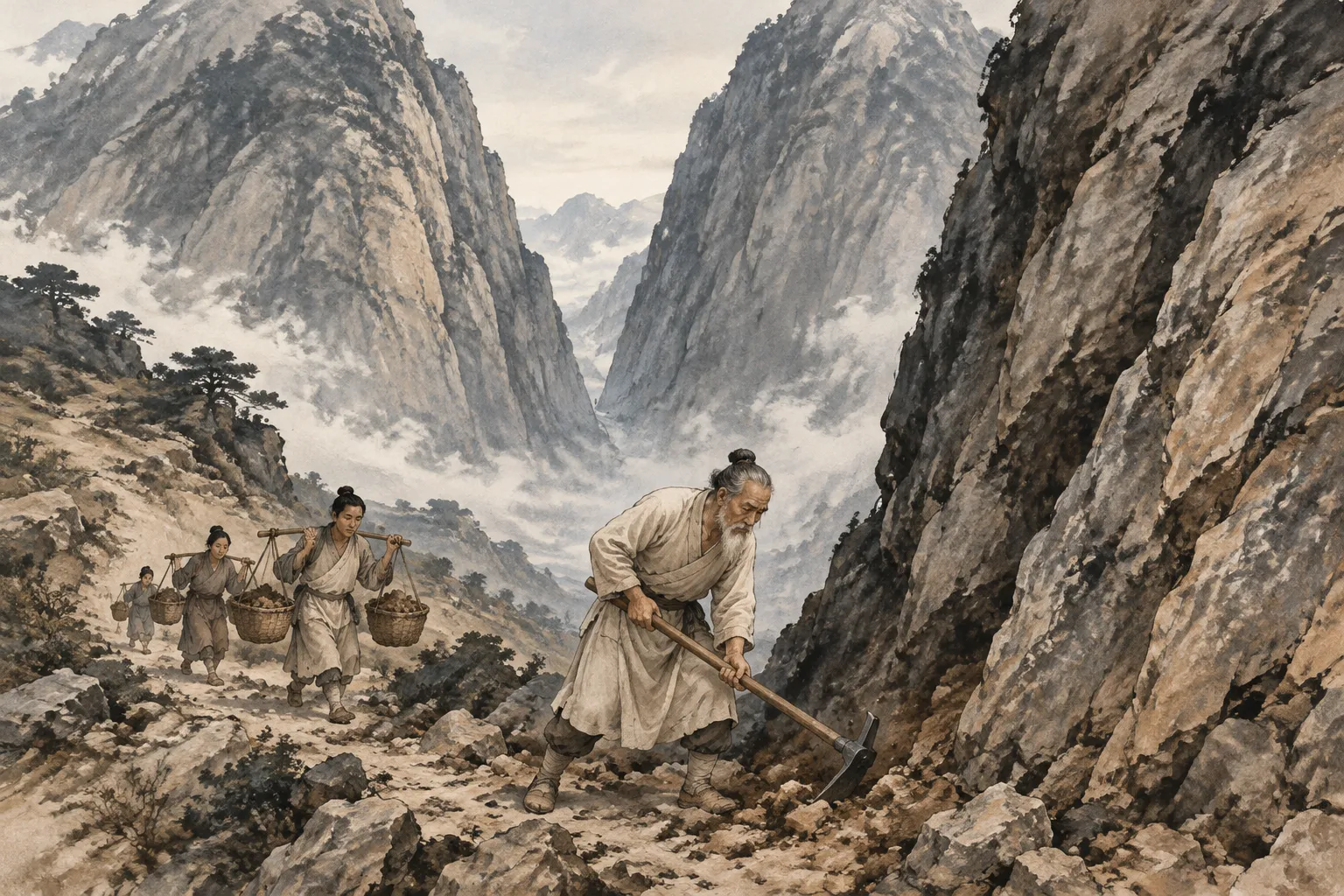
An old man faces two mountains with a hoe. Another old man laughs at him. The mountains are enormous, the workers few, and the proposed excavation seems absurd. Yet the digger has an answer: his descendants can continue after his death, while the mountains will not keep growing. Then comes the surprise. In Mao Zedong’s 1945 retelling, supernatural helpers carry the mountains away. Persistence matters, but human hands do not complete the excavation. That tension makes the ending worth reading closely in the published English version of Mao’s speech.
The story belongs to the Liezi, a Chinese philosophical collection associated with Daoist thought. Its later life, however, reaches beyond that setting. Following its movement from philosophical fable to political speech—and then to the name of a Beijing music venue—reveals how a recognizable story can acquire different purposes without losing its central image.
A story with a complicated textual past
The mountain-moving story appears in the fifth chapter of the Liezi, called “Tang Wen,” or “The Questions of Tang.” Before attaching a precise ancient date to it, however, we need to distinguish the traditional figure of Master Lie from the collection transmitted under his name. As the Internet Encyclopedia of Philosophy’s account of the text explains, both authorship and dating are disputed. The collection contains materials from different periods rather than a securely identifiable individual’s continuous work.
This distinction matters because calling the tale simply the teaching of a particular ancient philosopher creates more certainty than the evidence permits. The book has affinities with the Laozi and Zhuangzi, but its received form also reflects compilation and transmission. We can identify the story’s textual home without pretending to know exactly when someone first told it.
Its chapter provides an important interpretive setting. The encyclopedia describes “Tang Wen” as an exploration of extraordinary dimensions, unfamiliar possibilities, and the relation between the vast and the minute. Within that setting, an apparently insignificant person confronting mountains is not merely a handy illustration for a motivational slogan. The disproportion itself belongs to the chapter’s philosophical concerns: what looks possible depends partly on the scale from which one judges it.
Why the supposedly wise man loses
For a detailed, directly readable narrative witness, we can turn to Mao’s speech of June 11, 1945, delivered at the conclusion of the Chinese Communist Party’s Seventh National Congress. This is a modern political retelling, not a substitute for an edition of the Liezi. In its account, the Foolish Old Man lives in northern China, with his south-facing house obstructed by Taihang and Wangwu. He calls his sons together, and they begin digging. A second elder, designated the Wise Old Man, ridicules the attempt in Mao’s compressed version of the fable.
The names prepare an inversion. The supposedly sensible observer assesses a few workers against two peaks and concludes that the undertaking cannot succeed. The supposed fool changes the calculation. His own death need not end the work: sons, grandsons, and further descendants can continue, while each removal of earth makes the obstacle smaller.
Read as an argument, this does not demonstrate a workable engineering project. It assumes that future generations will keep doing the same thing. Its narrative force lies elsewhere: the critic treats one visible group’s immediate capacity as the limit of all future action. The digger refuses that limit. This is an interpretation of the exchange, not evidence that the story’s compilers endorsed every long-term undertaking regardless of cost.
The encyclopedia offers a related philosophical reading of the Liezi: great results can emerge from attention to what one can do now, even without comprehensive foresight. That makes the tale more interesting than a contest between intelligence and stupidity. The apparently wise assessment may be too narrow, while apparently foolish action can produce consequences beyond its initiator’s understanding.
The supernatural ending is not an optional extra
In Mao’s English-language text, the digger continues after answering his critic. A divine power is moved, and two supernatural assistants remove the mountains on their backs. The translation calls them “angels.” That vocabulary belongs to this particular English rendering; it should not be treated as proof that the Chinese narrative inhabits a Christian religious world. The essential narrative fact is that help beyond ordinary human capacity completes the task in this published version.
Removing that intervention changes the story. A summary saying that the family eventually excavated both mountains would turn an extraordinary rescue into a straightforward account of accumulated labor. Here, determination does not merely subtract earth. It elicits a response that transforms the conditions of the undertaking.
One possible reading is that persistence becomes effective by attracting assistance. Another emphasizes the mismatch between limited human knowledge and a result larger than anyone could directly accomplish. Neither requires us to regard the episode as documentation of a particular community’s ritual practice. A supernatural event within a philosophical narrative is not, by itself, evidence of a ceremony or a universally shared religious doctrine.
Readers interested in another Chinese narrative of radically disproportionate effort can turn to why Jingwei keeps trying to fill the sea. The useful connection is the question of how to understand an undertaking whose scale overwhelms its worker—not an assumption that the stories have interchangeable meanings.
What Mao changed in 1945
Mao does not leave the mountains as geographical obstacles. After recounting the fable, he explicitly identifies two political mountains: imperialism and feudalism. He presents the Communist Party as committed to removing them and urges sustained collective effort. Most importantly, he identifies the divine power with the Chinese people in the speech’s explanation of its own allegory.
This is not simply the deletion of a supernatural ending from an older tale. The ending remains, but its agency is reinterpreted. Assistance that seemed to descend from beyond human society becomes the mobilization of people outside the initial group of workers. The diggers’ task is therefore not only to persist themselves, but to bring others into the undertaking.
The speech’s immediate context makes that choice intelligible. Mao is addressing party members after a congress and asking them to explain its program to wider audiences. The familiar narrative supplies a compact model for the relationship he wants between committed organizers and a much larger population. This describes the speech’s political use of the story; it does not establish that this was the Liezi episode’s original purpose.
Keeping the witnesses separate preserves what is distinctive about each. The philosophical collection explores scale and the limits of ordinary judgment. The 1945 speech makes explicit identifications suited to a revolutionary program. A later retelling can be historically important without becoming the definitive explanation of its predecessor.
When the mountains became a music venue’s name
The story’s afterlife did not remain confined to philosophical reading or political speeches. Heidelberg University’s A Continuous Revolution project documents a Beijing music bar that opened in 2004 under the name Yugong Yishan. Its archived logo showed a man chipping at monumental Chinese characters representing the story’s name. The project observes that neither Mao nor the Liezi featured prominently in the venue’s self-description documented there.
This is a specific historical example, not a claim about the venue’s present operation or every visitor’s interpretation. Nevertheless, it demonstrates another kind of reuse: a story can supply a memorable name and visual identity without requiring its users to explain the entire chain of transmission.
Who, then, moved the mountains? The answer depends on which witness we are reading and what kind of explanation we seek. In Mao’s narrated fable, supernatural helpers perform the decisive removal; in his political interpretation, the people supply the transforming power. The Foolish Old Man’s enduring achievement is to begin an undertaking whose completion exceeds him. Keeping that distinction visible restores the ending’s surprise—and lets us see adaptation at work rather than mistaking every version for the same lesson.
Sources and further reading
- Internet Encyclopedia of Philosophy: Liezi — textual history and a philosophical reading of “Tang Wen.”
- Mao Zedong, The Foolish Old Man Who Removed the Mountains — the published English text of the June 11, 1945 speech, used here as a modern retelling.
- Heidelberg University: Yugong Yishan music-bar logo — documentation of a specific later cultural adaptation.


